
Built-In Braai Spit & Rotisserie Kits for South Africa: Worth It?
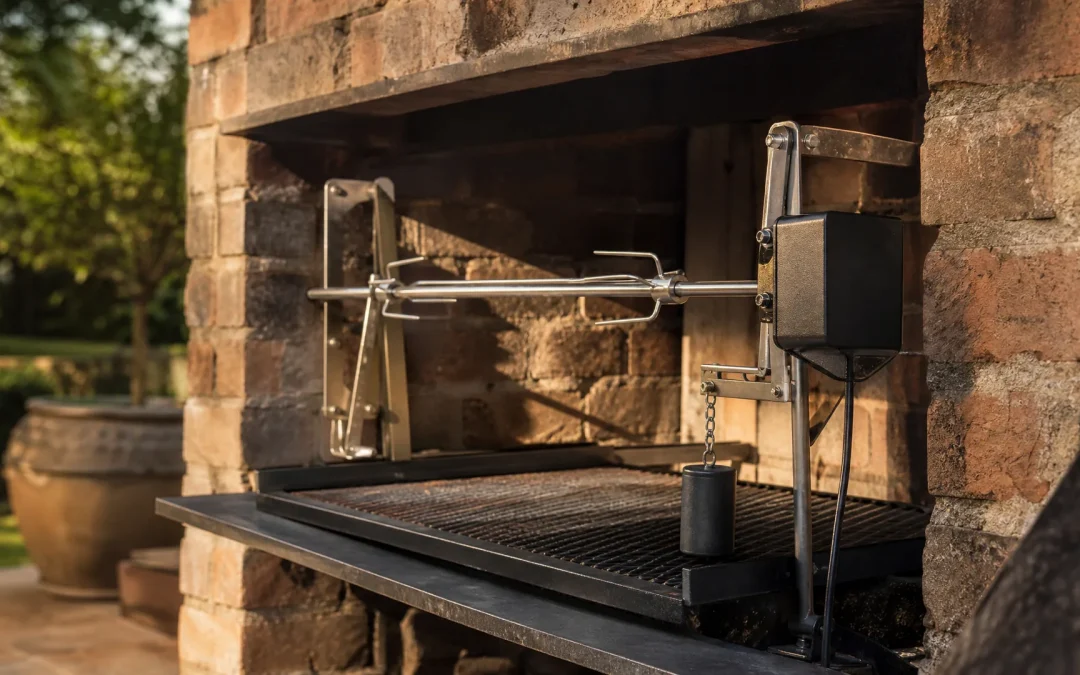
If you’re planning a built-in braai, the question of a spit usually comes up late in the process, often after the bricklaying has already started. That’s the wrong time to think about it. Built-in braai spit and rotisserie kits in South Africa work best when they’re part of the original design, not something bolted onto finished brickwork afterward. Here’s what you need to know before you commit to a layout.
What a Braai Spit and Rotisserie Kit Actually Does
A spit and rotisserie kit is simple engineering. It has four core parts: a motor, a spit rod, mounting brackets, and a counterweight.
The motor sits at one end of the braai, usually mounted on a bracket fixed to the brickwork or a metal frame. It turns the spit rod at a slow, steady speed. The rod runs through the centre of the meat. The counterweight balances out uneven loads, like a leg of lamb that’s heavier on one side.
As the rod turns, the meat rotates continuously above the coals. That gives you even heat on all sides and lets fat baste the meat as it drips and rolls around. So how does a braai rotisserie work? It’s really just controlled, slow rotation above a heat source.
Braai Spit vs Rotisserie: What’s the Difference?
In everyday South African use, people say “spit” and “rotisserie” interchangeably, and there’s no strict technical divide. But if you want a working distinction: the spit is the physical rod and frame that holds the meat. The rotisserie is the whole system, including the motor that drives it.
So the braai spit vs rotisserie difference is mostly about scope. A spit can be a simple manual setup you turn by hand. A rotisserie kit adds the motor and electronics that do the turning for you. Most homeowners planning a built-in braai are really asking about the full motorised kit, not a manual spit.
Built-In Braai Spit and Rotisserie Kits in South Africa: Is It Worth the Add-On?
This is the question that actually matters for your budget: do you need one?
If your braai nights are mostly weeknight chops, boerewors, and the odd chicken, a spit is a nice-to-have rather than a necessity. A standard grid handles that kind of cooking fine. But if you regularly host bigger gatherings, or you’ve always wanted to do a whole lamb or suckling pig for a special occasion, the calculation changes.
A spit setup turns a once-a-year showpiece meal into something you can do whenever you like. It also becomes a talking point at gatherings. There’s something about a slowly turning leg of lamb that draws people to the fire.
Who Actually Uses a Spit Regularly
In our experience, the households that get the most out of a spit fall into two groups. The first are regular entertainers, people who host extended family, friend groups, or work functions at home several times a year. The second are those who specifically want to do whole-animal roasts: lamb, pig, or large cuts that don’t fit a standard grid comfortably.
If neither describes you, you can probably skip the spit and put that budget toward other features. If either does, plan it in from the start. We’ll get to that shortly.
Choosing a Braai Spit Motor: Power and Weight Capacity
Not all spit motors are built the same, and this is where a lot of homeowners get caught out. A motor rated for a chicken or a small roast won’t necessarily handle a whole lamb.
Entry-level spit motors are generally built for loads up to around 20-25kg. Heavier-duty units designed for whole lamb or pig can handle 40kg or more. That gap catches out homeowners who only plan for chicken and small roasts. Then they find their motor labouring, or failing outright, the first time they load up something bigger.
Best Spit Motor for Whole Lamb or Pig
If whole-animal roasts are the goal, look for a motor rated well above your expected maximum weight, not just at it. A whole leg of lamb or a suckling pig needs a motor with enough torque to turn sustained off-balance loads for hours without straining. This is where cheaper, low-torque motors tend to struggle.
It’s better to slightly oversize your motor choice than to undersize it. A motor working near its limit wears out faster and can stall mid-cook. That’s the last thing you want with guests waiting.
Matching Motor Torque to Load
Weight capacity alone doesn’t tell the full story. Torque matters just as much. A whole lamb isn’t evenly balanced on the rod, so the motor has to keep turning through the heavier side without slowing down or straining.
Really, this is about matching torque to your typical load, not just picking the biggest number on the spec sheet. If you’ll mostly do chicken and smaller roasts with the occasional lamb, a mid-range motor with solid torque usually covers you. If whole lamb or pig is the regular plan, go for a purpose-built, higher-torque motor from the outset.
Designing the Spit Into Your Braai From Day One
This is where planning ahead really pays off. Firehouse’s team fields regular questions from homeowners mid-build about whether to leave space for a spit motor. It’s one of the most common design add-ons requested after the initial braai layout is finalised, and by then it’s a harder, costlier change than it needed to be.
Deciding early means your builder can plan the brickwork, brackets, and electrics around the spit from the outset, rather than trying to retrofit them into a structure that’s already set.
Positioning Within the Braai Structure
Positioning the spit at the right height above the coals matters more for even cooking than motor brand alone. Adjustable brackets set higher than a standard grid give you the clearance you need for a whole lamb or pig to rotate without dragging in the coals.
This height requirement affects the internal dimensions of your braai chamber. If you’re still working out the shape and size of your build, think about spit clearance at the same time as you’re choosing the right braai size for your garden. A compact braai may not leave enough vertical room for a full rotisserie setup.
Power Points, Brackets and Budget Impact
A motorised spit needs power. That means an outdoor-rated plug point positioned close enough to the motor mount, but far enough from the heat and any potential splash zones to be safe.
Getting this wired in during the build is straightforward and relatively cheap. Chasing new electrical conduit into finished brickwork after the fact is not. It usually means cutting into plaster or tile work you’ve already paid for.
Retailers who curate premium braai ranges generally advise deciding on spit inclusion at the design stage. Retrofitting brackets and power points into finished brickwork costs far more than building them in from day one. Budget-wise, adding a spit at the planning stage typically adds the cost of the motor, brackets, and a bit of extra wiring. If you’re mapping out overall costs, factor this in early when you work out how much you should budget for a braai build, rather than treating it as a surprise line item later.
If you haven’t settled on your overall layout yet, this is also a good moment to look at planning your built-in braai design from scratch, since spit placement is easiest to solve when it’s part of the original floor plan rather than squeezed in afterwards.
Spit Braai Accessories and Setup for Entertaining
A motor and a rod are the starting point, but a few extras make spit braai setups for entertaining much easier to manage. Drip trays catch fat and juices before they hit the coals, cutting down on flare-ups. Counterweights keep uneven loads turning smoothly, which matters more than people expect once you’re a few hours into cooking a whole lamb.
Spit forks lock the meat in place on the rod and stop slipping and uneven cooking. Some setups also include heat shields or adjustable coal trays, giving you more control over cooking temperature during a long, slow roast.
None of this needs to be complicated. When you’re comparing full setups, it helps to know what to look for in a built-in braai kit, since many spit-ready kits bundle the motor with the brackets and accessories you’ll need rather than making you source them separately.
For entertaining, a spit setup does a lot of the hosting work for you. It’s a slow, visible centrepiece that keeps guests near the fire and gives the evening a natural focal point, especially if your outdoor area is built for gathering. If you’re still shaping that space, think about designing your outdoor entertaining space around the braai and spit together, rather than treating them as separate decisions.
Getting Expert Guidance Before You Build
Deciding whether to include a spit, and getting the motor, positioning, and power supply right, isn’t something you need to figure out alone. It’s a common enough request that experienced retailers and builders can talk you through the trade-offs quickly, based on how you actually plan to use your braai.
If you’re weighing up brands and want a sense of what’s worth investing in, it’s worth looking at premium braai brands worth investing in before you finalise your build. And once you’re ready to move from planning to sourcing, there’s guidance available on where to buy a built-in braai in South Africa to help you take the next step.
If you’re mid-planning and unsure whether a spit fits your design, layout, and budget, talk to Firehouse’s team. We help homeowners work through exactly this kind of decision every day, and we’d rather you ask now than wonder later why the bracket wasn’t built in from the start.